
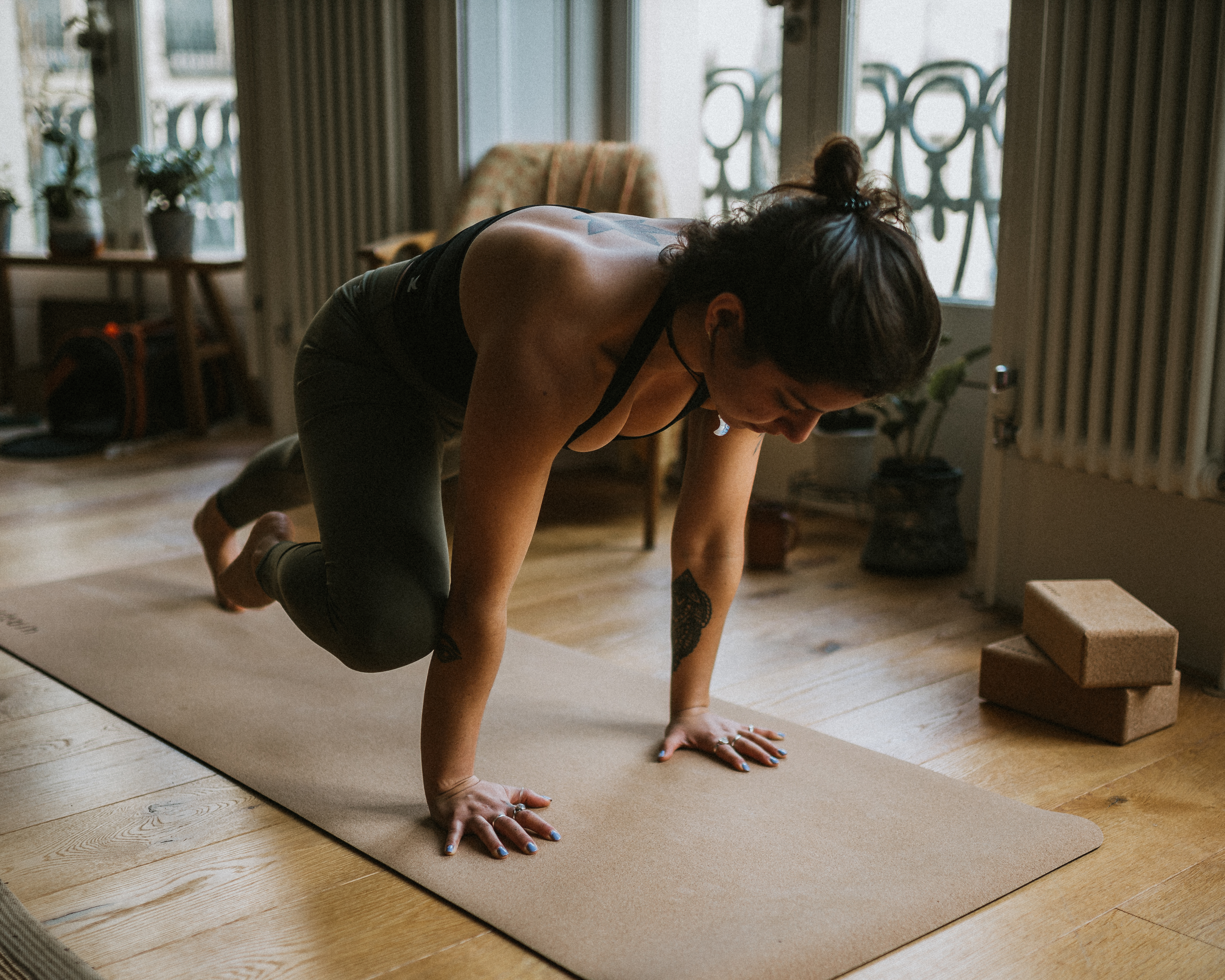
Natural movement is whatever YOU make it out to be. Everything is natural and everything unnatural, and this state is as interchangeable as it is fluid. Throughout this article, I’m going to try and breakdown different variables that can influence what natural movement is to us, as individuals. Now, this is quite a nuanced topic with loads of different avenues to travel down for analysis, which I obviously can’t cover, but this is my two cents based on my experience and understanding.
*
First of all, I think there is a lot of confusion and poison around the phrase ‘natural movement’ within the fitness industry. It’s a very elitist perspective which shouldn’t hold any metric over what movement is the golden standard for everyone, because each and every single one of us will find enjoyment from different movements and training patterns. That is what makes us INDIVIDUALS. There is never a one size fits all and it shouldn’t be dictated to us what we choose to engage in movement wise.
Secondly, when I hear people make the superior claim that body weight training is more ‘natural’ than movements which make use of external apparatus (e.g. a barbell) they’re completely discounting the following… If we’re performing a squat, our central nervous system (CNS) doesn’t care, or distinguish, whether we’re doing it with a barbell, our body weight, a log, or a resistance band etc. All it knows is how to respond and adapt to the stimulus we have given it through neurological adaptations and signals sent to our muscle fibres. What we have done as humans, is we have assigned a subjective value onto those said objects and given them different meanings. That’s it. Take this example: we have two people. The first can do one body weight pull up as their maximum and the second is able to do a pull up with 30kg attached to them as their maximum. Both individuals are maxing out, and both CNS’s are working in the same way by doing their best to recruit and expend the muscles fibres necessary to complete the movement. So regardless of whether you’re holding a metal thing or not, the same energy substrates is used, eliciting the same physiological response.
Whilst we’re on this stream of consciousness, humans are a product of nature and everything we have created is also a product of nature - from the iPhone, to cars to external apparatus like the barbell. It is in our human nature to create, build and adapt. So if external apparatus helps us adapt to get stronger in our movement, then surely that is natural? Therefore, the entire argument that body weight training is more natural than those which make use of objects like a barbell is simply flawed, redundant and mistakenly reductionist. All you body weight movement preachers can come down from your high horses now.
Cool, now that we got that noise out of the way, I’m going to highlight some bio-psycho-social approaches to what makes a movement natural in our minds, and try break down influential factors within each:
ADAPTATION
I’ve been practicing yoga a lot longer than I have ever bothered to run, so of course it is going to feel more natural to my body to do the first. Why might this be? Because quite simply, I haven’t spent the time or energy for my body and physiology to adapt to the stimulus of running, whereas I have for yoga. As a result, whatever feels more natural to us can be dependent on how much time we have allowed and given our body to respond and adapt to the movement - through things like progressive overload and repetition. Surely then, the argument goes, that any movement can become natural as our body will adapt to it over time as long as we provide it with that stimulus. Therefore, natural is a fluid state in relation to movement.
OUR PREEXISTING BIOLOGY
Women produce the hormone relaxin, which is there for when they give birth, meaning they are inherently more predisposed to be flexible - particularly in the hips and pelvis. So, movements like yoga or dance can come more naturally to them because of this biological predisposition. Whereas men produce larger quantities of testosterone, giving them a head-start when it comes to strength and muscle hypertrophy. Therefore, movements like powerlifting or UFC can come more naturally to them. Again, with time and dedication both women and men can work to make movements more natural to them in spite of their biology. They might have to work a little bit harder than the other sex to get there, but it shouldn’t put them off from engaging in it. Once again, what natural can feel like is influenced in part by our preexisting biology, depending on our sex, but it can also adapt with time.
OUR PHYSIOLOGY
Things like bone structure, joint hyper mobility, muscle fibre types, breathing dynamics and posture can also predispose us to finding x movement more natural than y. Let’s look at some examples:
A lot of hypermobilie individuals are drawn to similar movements, because their physiology dictates those movements to be easy. Of course though, those who are hyper mobile (like ya girl here) would benefit hugely from strengthening their muscles and joints through weight training / strength and conditioning in order to avoid long term tissue, tendon and ligament damage. It may not come naturally to them at first to engage in this movement with external apparatus, because joint stabilisation under a load requires more neurological stimulation than most body weight movement. But as I said above, with time and exposure to that stimulus, it will begin to feel more natural.
We have two main muscle fibre types - type 1 being slow twitch and type 2 being fast twitch. In the context of movement, someone with slow twitch muscle fibres will find it harder (perhaps more unnatural) to produce force, speed and power but have a greater resistance to muscular fatigue. They would therefore be more naturally suited for long distance running as opposed to sprints. The opposite applies to someone with fast twitch muscle fibres as they would produce force, speed and power easier but their muscles will fatigue quicker - movements involving interval sprints might therefore feel more natural. Muscle fibre types can be trained, it just takes a lot of time and hard work, meaning the individual may have to work harder in order to achieve a movement that their physiology has predisposed them to not feel natural doing.
GENDER STEREOTYPES
From a young age, girls and boys are told what sports to be involved in at school. More often than not, boys do football / rugby, girls do dance / netball (I know this differs from country to country, but this was my experience). This assignment of sports / movement is based heavily on gender stereotypes (what is feminine and masculine), and perhaps draws on elements of our preexisting biology as I spoke about above. However, this has lifelong implications for how we grow up to understand and view what movement we should do in our adult life. Let’s look at some examples:
Men are biased into more ‘masculine’ or ‘testosterone’ fuelled movements like weight training or football, whereas women are biased into more ‘feminine’ and ‘gentle’ movements like yoga or dance. This is a harmful rhetoric because this can discourage men and women engaging in movements outside of their gender stereotypes, through an ingrained unconscious bias. To give some real world application, 85% of my yoga students are female, 15% are male. In the gym, particularly in the weight training area, I see 70% of users are males and 30% are female. This highlights the underlying stereotypes of movement that we’re conforming to still as a society, which will then directly impact how we view what a natural movement is for our sex and influence that engagement.
I’ve heard comments from men saying that they don’t want to do yoga because its for “middle aged women” or looks “too feminine, fluffy and is just stretching” and I’ve also heard women say they don’t want to lift weights because they “don’t want to get bulky or look manly”. None of these comments should hold any weight, as they’re simply based on deeply ingrained and patriarchal stereotypes. Lets dispel these harmful comments…yoga was originally for 14 year old Indian boys and does required a lot of bodily awareness to engage in so it is not a ‘fluffy’ movement practice. To get bulky / muscular as a woman will take a lot longer and require more work in comparison to men, as there isn’t as much testosterone production which is one of the main hormones for strength and muscular hypertrophy.
In spite of this, I do understand why we still unconsciously conform to these gendered roles in our movement practice but I’d like to think it is changing in our society.
WOMEN’S HORMONAL CYCLE
Personally I have always moved / trained throughout my cycle, even on my period. However, the intensity, frequency and regularity of what I do at different phases will change to suit my body’s current needs. Let’s have a brief look:
During menstruation I find it more natural to keep moving and training - both yoga and lifting weights - as it helps me manage the cramps. This is not always the case, as sometimes the cramps are too much, but this is usually what happens.
In the follicular phase I often find I need to take is easier and slow down, so more gentle movement feels natural to me.
During ovulation my energy levels start to peak and I find myself wanting to do ALL THE ACTIVITIES AND MOVEMENTS. Like damn, I feel unstoppable with movement, play and training. So everything, as long as it’s not a brand new movement, feels natural to engage in.
When it comes to the luteal phase my energy fluctuates, I feel more bloated and hungry more often so motivation tends to wane. At this point, I try to listen to my body by slowing down and not forcing myself to move especially if it doesn’t feel natural.
These are just my personal experiences with movement in relation to my cycle, and of course every womb owner will be different. It highlights how the same movement can feel more or less natural during different phases of the cycle. So ‘natural’ can fluctuate within movement over time, and I believe there is a lot of value in trying to understand your personal cycle. It certainly has empowered me and led me to not feel guilty for not always being ‘on it’ with movement.
BIOMECHANICS
If we strip movements back to their biomechanics there perhaps could be the argument for movements being more natural. Hear me out:
The biomechanics of a squat are more natural for a person to perform than a handstand. Going back to hunter gather times, we were often in a squat position whether to go to the toilet (which is still present in some cultures), to cook and prepare food or build things. Whereas there isn’t any real evidence that would show handstands to be part of our primitive movement patterns or the biomechnical benefit to it.
However, as I mentioned above, the human body is adaptable and our biomechanics can adapt to be able to perform what ever movement we present it with (as long as its not rushed, with good form and awareness) such as doing a back squat with 200kgs or a contortionist doing a handstand with their lumbar spine touching their head. Of course these are extremes of each of the movements, but the point is again, that the body will adapt to the stimulus it is presented with. We have evolved to have this trait.
YOGA VS WEIGHT TRAINING
What originally influenced me to write this article was from two polls I put on my Instagram story, where I asked what people would define as a more natural movement.
The results were really interesting because for the first poll the majority said that a barbell back squat was more ‘natural’ than the yoga asana king dancer. Where as in the second poll, the majority favoured a forward fold over a sumo deadlift with a barbell. Of course the examples I gave were in relation to me and my movement / training, and may have had different outcomes if I chose different individuals for the examples.
Next up I asked people what their reasonings were and here are some examples (some of which I’ve paraphrased to make it easier to know which poll they are referring to), with my comments…
“I’ve never seen the need to do king dancer in day to day life, I feel I would use a squat movement more”
and
“The squat because it is a basic movement pattern but both are available so both are as natural as one another”
Totally agree with this, we’re more likely to use a squat or similar biomechanics of this movement (sitting down, picking something up) in day to day life, than this particular yoga asana. That doesn’t mean that the yoga pose can’t or shouldn’t be practiced because it is not a ‘functional movement’ (another buzz word I hate because of its connotations). Yes, the squat might be more accessible to most people, as it is within our natural range of motion, but as I keep saying, we can train and allow our body to adapt to different movements so they become increasingly more natural - like king dancer.
“We’re not supposed to lift anything heavier than ourselves, so I chose the yoga pose”
and
“Yoga is the natural movement and flow of body. Weight training is not a natural activity”
I disagree, completely. As a species we evolved by lifting heavy things - our prey, materials to build shelter etc. Without doing so, we wouldn’t be here. We also still do with things like heavy shopping or moving house. The second comment also comes back to the elitist mentality of body weight training vs training with an external apparatus. Again, as we evolved we did what we would now call weight training - lifting heavy logs or rocks that would mimic today’s movements like a deadlift or a squat. The physical practice of yoga came around far after this form of ‘weight training’, as it occurred after we had civilised societies.
“The yoga pose due to thinking it was less tense on the body, and you looked more relaxed in it”
and
“The yoga pose involves natural bending, so there is no strain on your joints”
I think this is a huge misconception about the practice of yoga - about it being less tense or not producing strain on the physical body. The amount of injuries to joints and muscle attachment points I’ve seen from yoga practitioners is just as much as I’ve seen in those who regularly lift weights - both can be done just as recklessly. A lot of yoga practitioners regularly go beyond their active range, ending up with very long and weak muscles susceptible to tears, tendon and ligament damage, or unstable joints with impingements. So no, yoga is not better for your body in that regard.
Again, it is about having a balance between the two goals of flexibility and strength, to develop all round mobility. You can’t do too much of one, and not the other, and expect to walk away without any injuries. It’s also about bodily awareness and not pushing into something you’re not ready for, which is a common trait in both movements.
Finally, being relaxed in something isn’t a good enough metric for what constitutes a ‘natural’ movement. I looked more relaxed in the forward fold because it was a static hold and a posed photo. In the deadlift photo I was dynamically going through the movement and all my attention and concentration was on the lift in order to perform it safely and properly. If the weight was lighter, it would be less of a high stress stimulus, but also if I were to have pulled deeper into the stretch, it would also have provided a higher stress stimulus and wouldn’t be so relaxed. So of course my body language looks more intense.
These ones just made me smile…
“The forward fold is a good stretch, the deadlift is a power pose to scare predators away”
and
“Neither (or both!), do whatever the hell makes you happy!”
and
“Normalise women lifting”
All of the movements feel natural to me, but of course that is based on my current goals, what is working for me and how long I’ve been doing them so that they feel more natural. There are times when both my yoga practice or strength training don’t feel as natural to me - when I’m figuring out a new pose or lifting a previously untouched weight. Regardless of the movement, mindful and conscious application of the practice is how it is made more natural for the body, and central nervous system to accept, as you can tune in and recognise your body’s needs more accurately. There is no point doing either without awareness.
Something only feels unnatural until it’s not anymore.
*
Let’s summarise this bad boy then…
What natural movement is, is very personal and subjective. It comes from knowing your body’s current needs, which will happen over time through experimenting with various movements and having a present awareness of the self. The state of what is natural will always be in flux, for various reasons, so it is our job to meet our personal needs. The human body is designed to adapt, over time, to whatever stimulus it is presented with. Whatever stress we submit our body to, that slaps it out of homeostasis, so long as its not too high and injurious beyond its current capacity.
In spite of pure biomechanics, predisposed biology / physiology, psychological or social factors, we CAN make more alien movements feel more natural to us. Our aim with movement should be geared towards performing day to day tasks functionally well (without strain, injury, better mechanics, better loading in the joints, muscle activation) to encourage longevity to our body, but also do movements that are fun and enjoyable where our mind and soul find joy, freedom and happiness. The needs of our body, mind and soul all need to be met. Our journey with movement should aim to empower our understanding of these facets, so we learn more about the self and can find deeper fulfilment in them.
Surely that, is the most natural thing?